How Sora 2 AI Video Generation is Redefining Ad Creative
Learn how to scale Facebook ads with proven strategies. Our guide covers budget pacing, audience expansion, and creative testing for maximum ROAS.
Thinking about scaling your ad campaigns? It’s not just about cranking up the budget and hoping for the best. True scaling is a methodical process built on a campaign that has a continuous pipeline of high-performing video creative.
The whole game is about building a rock-solid creative engine first. Only then can you start exploring growth strategies, like using a Sora 2 video generator to produce endless ad variations or a Sora 2 storyboard generator to map out compelling narratives, without torching your return on investment.
Building a Profitable Foundation with AI Video
Before you even think about pouring more money into a campaign, you need to be dead certain your creative can scale with your budget. So many advertisers make the same costly mistake: they try to scale a campaign with a single winning ad, only to watch it burn out from ad fatigue.
This first phase is all about confirming that your core offer is a hit and that you have a system to produce fresh video content that connects with people. It's the difference between building your house on bedrock versus shifting sand.
The very first step is to pinpoint what a truly 'winning' video ad looks like. I'm not talking about one good day; I'm talking about sustained, predictable performance. You really want to see stable results over a 3-7 day window. That’s the sweet spot—long enough to smooth out the daily ups and downs and give you a real sense of how a video concept is actually performing.
Key Metrics That Signal a Winning Creative
Dive into your data and look for these green flags. You’re hunting for a consistent Cost Per Purchase (CPP) and a healthy Return on Ad Spend (ROAS) that either meets or beats your targets. If you have an ad generated with powerful Sora 2 prompts that’s humming along profitably at $50 a day for a week straight, that’s a fantastic sign the concept has the legs to perform at $75 or even $100 a day.
A campaign isn't ready to scale until it has a system for replacing fatigued ads. If your creative pipeline is dry, increasing the budget will only amplify ad fatigue and burn through your cash faster.
To make this crystal clear, I've put together a quick checklist. Run through this before you add a single dollar to your budget.
Creative Readiness Checklist: Are Your Videos Ready for More Budget?
Scaling prematurely with a single ad is one of the most common and costly mistakes advertisers make. Use this checklist to confirm your campaign has a stable creative foundation before you commit more spend.
| Checklist Item | What to Look For | Why It Matters |
|---|---|---|
| Consistent ROAS/CPP | Stable performance from your current winning ad over 3-7 days | Unpredictable results get worse at higher spends, not better. |
| Sufficient Conversion Volume | At least 25-50 purchases per ad set per week | Provides enough data for Meta's algorithm to optimize effectively. |
| Creative Pipeline Ready | A system, like a Sora 2 AI video generator, to produce new ads | Scaling works best when you can quickly replace fatiguing ads. |
| Pixel & CAPI Health | Event Match Quality score is "Good" or "Great" | Poor data tracking means Meta is optimizing based on incomplete info. |
| No Audience Fatigue | Frequency below 3.0 in a 7-day period | High frequency means your ads are burning out your audience. |
If you can confidently check off these boxes, you're in a great position to start scaling. If not, pause and focus on building your creative testing system first.
The Technical Must-Haves
Beyond just the performance numbers, your technical setup has to be flawless. This part is completely non-negotiable. Your scaling decisions are only as good as the data you're collecting.
- Meta Pixel: Make absolutely sure your Pixel is installed correctly and firing on all your key events—especially Add to Cart, Initiate Checkout, and, of course, Purchase.
- Conversions API (CAPI): CAPI is your Pixel's best friend. It creates a more durable server-to-server data connection that isn’t derailed by things like browser updates or ad blockers. A properly configured CAPI is mission-critical for accurate attribution as you scale.
Without clean, reliable data from both the Pixel and CAPI, you're essentially asking Meta's algorithm to fly blind. You simply can't optimize what you can't accurately measure, which turns any scaling attempt into a pure gamble.
And don't forget the human element. Managing the public perception of your ads through effective Facebook Ads comment moderation is a surprisingly critical piece of the puzzle. A stream of negative comments can tank the performance of a winning ad fast, so having a system to handle them protects your investment as you scale.
Once your data is clean and your performance is steady, you're ready to confidently move to the next stage of growth.
Choosing Your Scaling Method: Vertical Versus Horizontal
So, you've got a campaign that's humming along, delivering stable and profitable results. Awesome. Now comes the exciting part: how do you actually grow this thing without breaking what's already working? Scaling isn't just about cranking up the budget; it's a strategic decision.
Your first major choice is between two fundamental approaches: Vertical Scaling and Horizontal Scaling. Think of vertical as going deeper with what you have, and horizontal as going wider to find new opportunities. The right path depends on your campaign's performance, audience size, and ultimate business goals.
This decision tree gives you a quick visual checklist for the go/no-go decision. Before you even think about scaling, you need to be able to tick these boxes.
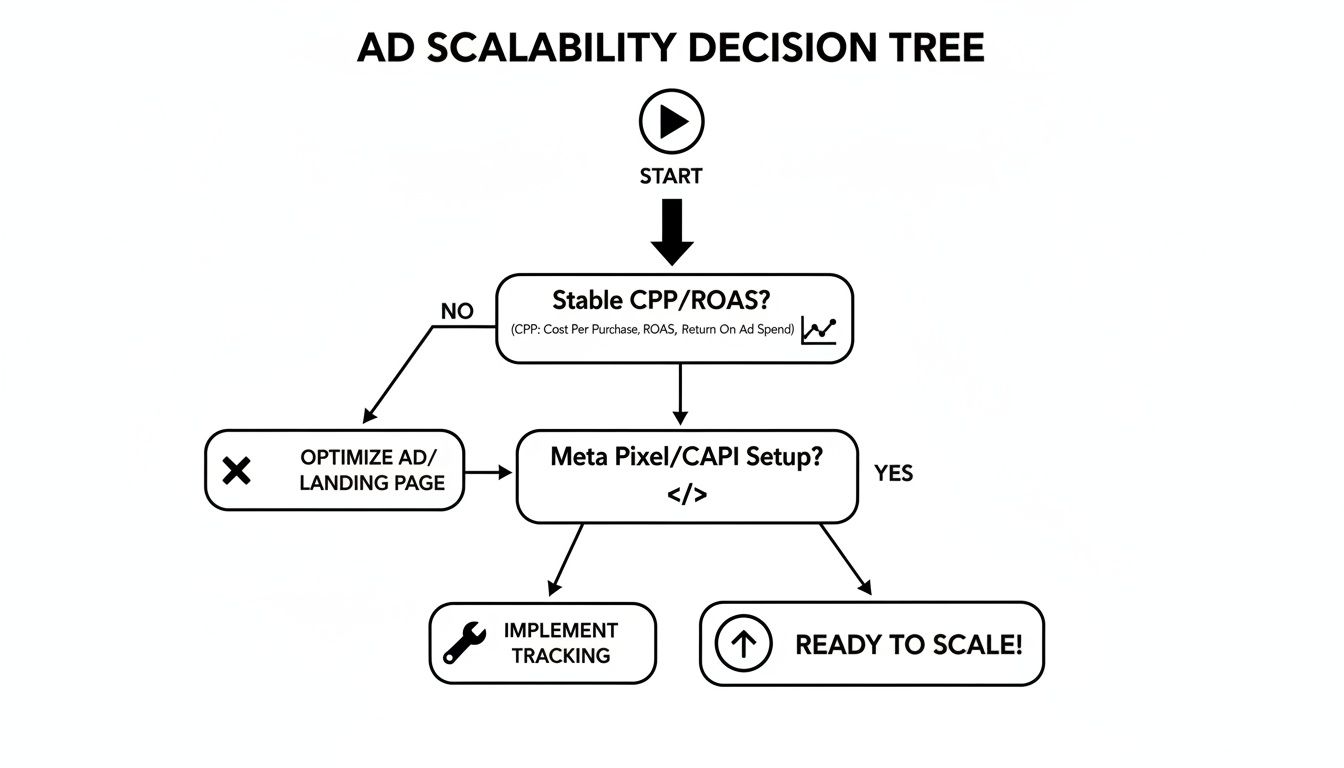
As you can see, the non-negotiables are consistent performance (a stable cost-per-purchase or ROAS) and a rock-solid data connection through the Meta Pixel and CAPI. Get those right first.
Go Deep with Vertical Scaling
Vertical scaling is the most direct path forward. You’re simply increasing the budget on your existing, top-performing ad sets or campaigns. If something is working incredibly well, the logic is to give it more fuel to get more of those same great results. You're doubling down on a proven winner.
Let's say you're a Shopify store owner with an ad set consistently hitting a 3.5x ROAS on a $50/day budget. This is a perfect candidate for vertical scaling. By carefully bumping up the budget, you're signaling to Meta's algorithm to find more people who look and act just like your current buyers.
This method works best when you’ve found a profitable sweet spot within a large audience. It allows you to extract as much value as possible before you need to start looking for new ponds to fish in.
Pro Tip: Be careful not to make drastic budget jumps. A sudden 2x or 3x increase can throw the algorithm for a loop, forcing your ad set back into the learning phase and potentially tanking performance. Slow and steady wins the race here.
Go Wide with Horizontal Scaling
Horizontal scaling, on the other hand, is all about expansion and discovery. Instead of pouring more money into a single winning ad set, you duplicate it and test it against entirely new audiences. The goal is to find fresh, untapped pockets of customers who respond just as well as your original group.
This is my go-to strategy when I see signs of audience fatigue. If you notice your ad frequency is creeping up and your ROAS is starting to slide, that’s Meta’s way of telling you it’s time to find new people.
Here’s what horizontal scaling looks like in the real world:
- Test New Lookalikes: Take your winning ad set, duplicate it, and start testing different Lookalike Audiences. You could try a 1% Lookalike of your customer list, a 3% Lookalike of people who initiated checkout, or a 5% Lookalike of your top-spending customers.
- Explore Fresh Interests: You can also duplicate the ad set to test completely new, but related, interest audiences. If "yoga mats" worked, try targeting interests like "meditation" or "Pilates."
- Go Broad: Once you have a ton of conversion data, you can even duplicate the ad set and remove all targeting. This is called "broad targeting," where you trust Meta's algorithm to use your pixel data to find the right people on its own. It's surprisingly effective for mature accounts.
This approach diversifies your ad account and makes you less dependent on a single audience—a huge win for long-term, sustainable growth.
Ultimately, choosing between vertical and horizontal scaling isn't a one-time decision. The best media buyers use a hybrid model. They scale vertically on their best performers until they hit a ceiling, then they pivot to horizontal scaling to unlock new avenues for growth.
Mastering Budget Pacing with an AI-Powered Creative Pipeline
Ramping up your ad spend too quickly is the single fastest way to shock Meta's algorithm and watch your campaign performance collapse. I've seen it happen countless times. True scaling is a disciplined art, not a reckless sprint, and it all comes down to a smart, practical framework for pacing your budget, supported by a powerful creative engine.
When you jump from a small budget to a massive one overnight, you force your ad sets right back into the dreaded "learning phase." All that hard-won progress? Gone. This sudden jolt sends your ROAS plummeting as the algorithm scrambles to find new customers at a much faster rate, which almost always leads to inefficient, panicked spending. The key is to grow sustainably, not erratically.

Embrace the 20-25% Rule
If you take one thing away from this section, let it be this: the golden rule for scaling is to increase your daily budget by no more than 20-25% every 24-48 hours. This isn't just a random number; it's a principle backed by years of in-the-trenches experience from performance marketers. This gradual increase gives Meta's algorithm enough breathing room to adapt to the new spend level without throwing your performance into chaos.
This deliberate approach is all about maintaining stability. Let's say a brand is using a tool like Saro2.ai to generate a high volume of video ads and finds a winner that's humming along at $100 per day. The amateur move is to get excited and double the budget. The pro move? Nudge it up to $125. Then you wait a day or two, confirm the performance holds, and repeat the process.
This disciplined, incremental approach is what separates sustainable growth from the boom-and-bust cycle many advertisers get trapped in. Patience here directly translates to profitability.
Following this methodical pace keeps the algorithm happy, your campaigns out of the volatile learning phase, and your cost per acquisition stable as you grow.
When to Adjust Your Pacing Strategy
Now, while the 20-25% rule is a fantastic guideline, it isn't set in stone. Your budget level and how much risk you're willing to stomach play a huge role here. Context is everything.
Low Budgets (Under $100/day): When you're working with smaller daily spends, you can afford to be a bit more aggressive. The algorithm is far less sensitive to larger percentage jumps when the actual dollar amount is low. Doubling a budget from $50 to $100 is a common move that’s often perfectly safe.
High Budgets (Over $500/day): Once you're spending hundreds or thousands a day, sticking to that 20-25% increment becomes non-negotiable. Think about it: a 50% increase on a $1,000/day ad set means you're asking the algorithm to effectively spend an extra $500 tomorrow. That’s a massive shock to the system and almost guarantees your performance will tank.
Imagine you're an e-commerce store owner using a Sora 2 storyboard generator to create multi-scene product videos. You've found a winner and you're ready to scale it.
- Scenario A (Early Stage): Your winning ad set is at $60/day. Jumping to $100/day is aggressive, but it's a reasonable and calculated risk.
- Scenario B (Growth Stage): That same ad set is now crushing it at $600/day. A safe, smart increase would be $120-$150, bringing your new total to $720-$750/day.
The Importance of Patience and Observation
After every single budget increase, your job is to sit back, wait, and watch. Seriously, don't touch anything for at least 24-48 hours. You have to let the data roll in and give the algorithm time to find its footing at the new spend level.
During this waiting period, keep a close eye on your core KPIs:
- Return on Ad Spend (ROAS): Did it hold steady, or did it take a nosedive?
- Cost Per Purchase (CPP): Is your cost to get a new customer still within your target range?
- Click-Through Rate (CTR): Are people still clicking on your ad at the same rate?
If your metrics are looking good after 48 hours, you've got the green light to make another incremental increase. But if they drop, that's your signal to pause. You might need to let the budget settle for another day or two. Or, it could be a sign that you've maxed out that ad set, and it's time to start exploring horizontal scaling instead. This patient, data-driven rhythm is the very heartbeat of successful scaling on Meta.
Audience Expansion with Sora 2 Video Examples
So, you've pushed your budget as far as it can go with your winning audiences, and now you're seeing your returns start to dip. That's a classic sign you've wrung just about all the value out of that segment. It doesn't mean you've failed; it means it's time to pivot.
This is where horizontal scaling, powered by diverse AI-generated video, comes in. Instead of just pouring more money into what’s working (vertical scaling), you're now on the hunt for brand-new pockets of customers by testing custom-tailored Sora 2 video examples against new audiences.
Going horizontal is how you build a resilient, long-term growth engine. By diversifying your targeting and your creative, you stop being so reliant on a single audience, which makes your entire ad account less vulnerable to the inevitable performance swings. The playbook is pretty straightforward: build powerful Lookalike Audiences from your best customers, test new interest groups methodically, and eventually, learn when to take the training wheels off and let Meta's algorithm fly.
Build High-Intent Lookalike Audiences
Lookalike Audiences are your bread and butter for horizontal scaling. Think about it: instead of making educated guesses about who might buy your product, you’re literally telling Meta, "Here’s a list of my best customers. Go find me more people exactly like them."
The quality of your source audience is everything here. Garbage in, garbage out. You need to start with data sources that represent your most valuable customers—people who have already proven they love what you do.
- Your Customer List: This is gold. An uploaded list of past purchasers is the highest-quality, highest-intent data you have.
- High LTV Segments: Take it a step further. If you can, pull a segment of only repeat buyers or customers with the highest lifetime value (LTV). A Lookalike built from this group is incredibly potent.
- Pixel Purchase Events: Using data from your Meta Pixel is also great, but be specific. A Lookalike audience based on 'Purchase' events will trounce one based on a lower-intent action like 'View Content' every single time.
Once you have your source audience locked in, the next step is testing different percentages. This tells Meta how narrow or broad of a net to cast.
- 1% Lookalike: These are the people most similar to your source audience. You get maximum relevance here, but your audience size will be smaller.
- 1-3% Lookalike: This is often the sweet spot, giving you a solid balance between relevance and the scale needed for growth.
- 3-5% Lookalike: Now you're reaching a much larger pool of people, but they'll be less similar to your original customers. This is a great option once you’ve saturated the smaller percentages.
You have to test these methodically. Don't just assume 1% is best. Sometimes a 3% audience will outperform it because it gives the algorithm more room to work.
Systematically Test New Interest Groups
Lookalikes are fantastic, but don't sleep on interest-based targeting. This is your lab for testing entirely new customer theories. Let's say you've been crushing it by targeting people interested in "sustainable fashion." Horizontal scaling means testing adjacent interests like "ethical shopping," "vegan lifestyle," or even brands that share a similar ethos. With a Sora 2 text-to-video tool, you can even generate unique videos that speak directly to each of these sub-niches.
The trick is to be scientific about it. Duplicate a winning ad set and change only one variable: the interest you're targeting. This isolates your test and gives you clean data on what’s working. Resist the temptation to stack a bunch of new interests into a single ad set—you'll have no idea which one is actually driving the results.
Don't be too quick to judge. When you launch a new audience test, give it a real chance to succeed. That means a dedicated budget and at least 3-5 days to run before you even think about touching it. I’ve seen so many advertisers kill a potentially profitable audience on day two just because it wasn't an instant home run. Patience pays off.
Know When to Unleash Broad Targeting
This is going to sound crazy, but one of the most effective scaling strategies is to eventually remove your detailed targeting altogether. We call it Broad Targeting. You simply target a wide demographic (like Women 25-54 in the USA) with no Lookalikes or interests and just let Meta’s algorithm do its thing.
Here’s the catch: this only works if you’ve already given the algorithm a ton of good data to learn from.
After your Pixel has tracked hundreds (or ideally, thousands) of purchases, it has a crystal-clear picture of your ideal customer avatar. At that point, you can trust the system to find more of those people without you micromanaging the targeting. The algorithm, armed with all that conversion data, often knows who to target better than you do.
Going broad is the ultimate vote of confidence in Meta's machine learning. For mature ad accounts with a rich history of conversions, it can unlock a level of scale that's nearly impossible to achieve when you're boxing the algorithm in with restrictive targeting.
Keeping Ad Creatives Fresh with Sora 2 for TikTok Ads
Here’s a hard truth: even your best ad, the one that’s absolutely crushing it right now, will eventually die. It’s a classic case of ad fatigue, and it happens much faster when you start pouring serious money into your campaigns. The more you spend, the more you hit the same people, and the quicker they get tired of seeing your ad.
The only way to get ahead of this is to build a system for constantly testing new creatives. You need to have the next winning ad waiting in the wings before your current champion starts to fade. This is especially true for platforms like TikTok, where trends move at lightning speed. This is where using Sora 2 for TikTok ads becomes a strategic advantage.
This doesn’t mean you need a Hollywood-level production budget. It’s about being smart and agile, testing small variations to see what works, and then pouring gas on the elements that resonate with your audience.
Building Your Creative Testing Engine
The most efficient way I’ve found to do this is to run your creative experiments in a completely separate campaign from your main scaling efforts. Think of it as your creative laboratory. I almost always use Ad Set Budget Optimization (ABO) for this, as it forces the budget to be distributed evenly and gives each new ad a fair chance to prove itself.
Remember, the goal of this campaign isn't immediate profit—it's to gather data. You're isolating one variable (the creative) to see which hooks, angles, and formats actually grab attention.
For example, a DTC brand might set up a simple testing campaign with a $50/day budget. Inside, they could have five different ad sets, each with just one new video ad. This setup is perfect for finding the next creative to graduate into the high-budget scaling campaigns.
The Power of AI in Rapid Ad Generation
This is where things have gotten really interesting lately. A few years ago, testing five video concepts meant weeks of back-and-forth with a video editor and a hefty invoice. Today, AI video generators have made the whole process faster and cheaper than ever.
Tools like the Sora 2 text-to-video generator are changing how performance marketers operate. We can now spin up dozens of high-quality video ad variations from a simple text prompt. You can test different opening hooks, unique product shots, or various calls-to-action without the time and expense of a traditional video shoot. This speed is a massive advantage when you need a constant pipeline of fresh ads.
Let's say you want to test three hooks for a new product:
- Hook 1: A direct, benefit-driven opening.
- Hook 2: An intriguing question to build curiosity.
- Hook 3: A snippet from a customer testimonial.
With a tool like Sora 2, you could generate just the first three seconds for each of these ideas and stitch them onto your core product video. In a day, you can have three new ads ready to test which opening stops the scroll and drives the highest click-through rate (CTR).
The real secret to scaling creatives isn't about finding one "perfect" ad. It's about building a system that constantly surfaces new winning elements—hooks, visuals, and copy—that you can iterate on to stay ahead of ad fatigue.
Analyzing Performance and Promoting Winners
Let your tests run for a few days to collect enough data. When you check the results, don't just fixate on ROAS. You're looking for early signs of a winner.
- Click-Through Rate (CTR): Is one ad getting significantly more clicks? That's a great sign that the creative is doing its job and grabbing attention.
- Cost Per Click (CPC): Lower CPCs usually mean the ad is more relevant and engaging to the audience.
- Video Watch Time: Pay close attention to metrics like 3-second views and average watch time. This tells you if your hook is actually working.
Once you spot a creative that’s a clear outlier on these leading indicators, it’s time to promote it. You simply take this newly validated ad and introduce it into your main CBO scaling campaign.
This methodical cycle of testing, analyzing, and promoting ensures you're always feeding the algorithm fresh, data-backed creatives. It prevents the sudden performance drops that happen when an old ad finally burns out, keeping your growth smooth and sustainable. This is the engine that powers every successful large-scale ad account I've ever seen.
What to Do When Your AI Video Ads Hit a Wall
Let's be real: scaling a winning campaign is never a smooth, upward curve. Even the most seasoned media buyers run into roadblocks with their video creative. The real skill isn't avoiding these bumps; it's knowing how to diagnose and fix them fast. This is your field guide for navigating those inevitable creative pains.
When performance tanks right after you've bumped up the budget, the gut reaction is to panic and start tweaking everything. Resist that urge. The key is to methodically figure out what's really going on. Is it creative burnout? Audience saturation? Or did you just push the budget too hard, too fast?
Playing Detective: Why Did Performance Drop?
The second you see your ROAS dive or your Cost Per Purchase spike, it's time to put on your detective hat. The issue almost always comes down to one of three things: the creative, the audience, or the budget itself.
To find the culprit, you need to look at a few key metrics that tell the real story behind your campaign's health.
- Frequency: Are you seeing this number creep up? A high frequency, especially anything over 3-4 in a 7-day window, is a tell-tale sign of ad fatigue. It means the same people are seeing your ad over and over, and they've officially tuned it out.
- Click-Through Rate (CTR): If your CTR is dropping, particularly while frequency is rising, that's your confirmation. Your ad has lost its thumb-stopping power, and people are just scrolling on by.
- Cost Per Mille (CPM): Is the cost to reach 1,000 people (your CPM) suddenly skyrocketing? This usually points to one of two things: audience saturation or a flood of new competition. Either way, the algorithm is spending more to find people in your target audience.
Keeping a close eye on these numbers gives you the clues you need to make surgical fixes instead of just guessing and potentially making things worse.
Spotting a Tapped-Out Audience
Audience saturation is what happens when you’ve pretty much shown your ad to everyone in your target group who is likely to convert. The algorithm is now struggling to find fresh faces. Luckily, Facebook Ads Manager has built-in tools to help you see this coming.
Take a look at Facebook's delivery insights. It will often flat-out tell you when an ad set is struggling to spend its budget because of audience competition or saturation.
This little tool is gold. It helps you understand if a performance dip is because you've hit the ceiling with your current audience, which is a clear signal that it's time to start scaling horizontally.
Once you see these warning signs, stop pouring money into a dry well. It’s time to expand with new Lookalike percentages or test completely different interest groups.
Tackling Creative Burnout and Soaring CPMs
If high frequency and a tanking CTR are your main problems, the issue is your creative. It’s stale. It's had a good run, but its time is up. The fix here is to cycle in the fresh creative you've (hopefully) been testing on the side.
A common mistake I see is people trying to "fix" a failing ad by tweaking the headline or copy. By the time an ad burns out, it’s almost always the visual. Don’t edit it—replace it with a new, validated winner to get performance back on track.
But what if rising CPMs are the problem? The solution here is often two-pronged. First, broaden your audience. Give Meta’s algorithm more breathing room to find cheaper pockets of users. This is the perfect time to test a 3-5% Lookalike or even go completely broad if your pixel has enough data.
Second, think about how you can introduce completely new creative concepts. Tools like the Saro2.ai text-to-video generator can be a game-changer here, letting you quickly spin up novel video ads that can re-engage a tired audience. Sometimes, a totally fresh angle is all it takes to make a saturated audience feel new again and get your scaling back on the rails.
Common Questions on Using Sora 2 for Ads
When you start leveraging a powerful tool like the Sora 2 video generator, you're bound to run into a few tricky situations. Let's tackle some of the most common questions that pop up when you're trying to scale your campaigns with AI-generated video.
CBO vs. ABO: Which is Better for Testing Sora 2 Videos?
This is a classic debate, and the honest answer is: it depends on your goal.
CBO (Campaign Budget Optimization) is your best friend when you have a winning formula. You set the budget at the campaign level, and Meta’s algorithm does the heavy lifting, pushing your spend toward the ad sets and creatives that are delivering the best results. This is for your main scaling campaign.
ABO (Ad Set Budget Optimization) gives you direct control. You set a specific budget for each ad set, which is perfect for the testing phase. If you're trying out new Sora 2 video examples or fresh audiences, ABO ensures each one gets a fair shot and a dedicated budget to prove itself. You get clean data without one ad set hogging all the cash.
For a deeper dive into the strategic side of this, you can find more great insights on how to scale Facebook Ads effectively.
How Do I Know When It’s Time to Stop Using a Video Ad?
Knowing when to pull the plug on a video ad is just as important as knowing when to push the gas. You need to stop scaling when performance tanks and just won't recover.
The most obvious red flags are a consistent drop in ROAS below your target or a sudden spike in your Cost Per Purchase (CPP). When you see these numbers heading in the wrong direction for more than a few days, it’s usually a clear sign of either audience saturation (you've shown your ad to everyone who will buy) or creative fatigue (people are just tired of seeing the same ad). This is your cue to dive back into your Sora 2 text-to-video tool and generate the next wave of winning creative.
Ready to create high-performing video ads that are built to scale? With saro2, you can generate endless variations of cinematic-quality product videos from simple text prompts, helping you fight ad fatigue and keep your ROAS high. Get started for free today at https://saro2.ai.