Unlocking Video Storytelling with the Sora 2 Storyboard Generator
Discover how to use the Sora 2 storyboard generator for your next project. Create cohesive, multi-scene videos for TikTok, ads, and social media with ease.
Let’s be honest, turning a cool idea into a complete video used to be a massive headache. You'd spend days mapping everything out. Now, with a Sora 2 style model, you can build out a full-blown storyboard, shot by shot, in the time it takes to drink your coffee. We're not just talking about generating a few random clips here. We're talking about crafting a complete, cohesive story with an incredible amount of creative control.
Bringing Your Story to Life with AI Storyboarding
Forget static sketches. Imagine generating dynamic video storyboards that show you exactly what's in your head, instantly. This is a game-changer for marketers, filmmakers, and creators. You can iterate on ideas so much faster and see exactly how something will look and feel before you sink time and money into a full production. This is the power of the Sora 2 text-to-video engine: speed and creative freedom.
The buzz around this tech is real. When OpenAI launched its Sora 2 video generator, it completely changed the content creation game. Within just 48 hours, the Sora app hit #1 on the US iOS App Store with over 164,000 installs, even beating ChatGPT. That kind of explosive growth shows just how hungry people are for AI-powered video tools. You can get a deeper dive into the numbers from this analysis of Sora 2's launch success on intuitionlabs.ai.
Visualizing Concepts with Speed and Precision
The real magic of using a Sora 2 storyboard generator is how quickly you can turn a vague thought into a concrete visual sequence. If you're creating Sora 2 for TikTok ads, you could dream up, create, and test a dozen different ad concepts in a single afternoon. If you're a creator, you could outline an entire short film without booking a single location or hiring a crew.
Just look at the kind of high-fidelity Sora 2 video examples a style model can kick out from a simple text prompt. This isn't a grainy, abstract concept—it's a cinematic shot.
This shot proves the model gets it. It understands character, action, and setting, and then pulls it all together into something that looks polished and intentional.
Who Benefits from AI Storyboarding?
Just about every creative professional can find a way to make AI storyboarding work for them. It’s incredibly adaptable, whether you’re banging out quick social ads or doing detailed pre-production for a bigger project.
"The biggest advantage is the speed of iteration. What used to take days of planning and sketching now takes minutes with Sora 2 prompts. This allows for more creative risks and better final products because you can see what works—and what doesn't—almost immediately."
This technology isn't a one-size-fits-all solution; it offers unique advantages depending on what you're trying to accomplish.
How Different Creatives Benefit from AI Storyboarding
AI storyboarding isn't just a novelty; it solves real-world problems for a wide range of professionals. From e-commerce entrepreneurs trying to stand out to filmmakers mapping out complex scenes, this tool helps bridge the gap between imagination and execution.
| User Type | Key Benefit | Example Application |
|---|---|---|
| TikTok Sellers & Shopify Owners | Rapidly prototype video ads | Test different hooks and visual styles for a new product launch to see what drives engagement before committing ad spend. |
| Content Creators & Influencers | Plan multi-scene narratives | Create a consistent look and feel for a YouTube series or a multi-part Instagram Reel, ensuring character and style stay on point. |
| Performance Marketers | Generate endless ad variations | A/B test dozens of ad creatives by tweaking scenes, calls-to-action, and visual elements to find the highest-converting version. |
Ultimately, a tool like the saro2.ai storyboard generator puts a director’s toolkit right in your hands, accessible from any browser. It levels the playing field, making high-quality video planning available to everyone.
Planning Your First Multi-Scene Project
A great multi-scene video doesn't start with a killer prompt—it starts with a plan. Before you even touch the Sora 2 video generator, you need to map out your story. This initial groundwork is what creates a cohesive video, establishing the consistent characters, settings, and overall vibe that will tie every shot together.
Think of this as your pre-production phase. Spending a little time upfront structuring your ideas and outlining the key story beats will save you a massive headache later. It’s the difference between ending up with a jumble of cool-looking clips and a story that actually lands with your audience.
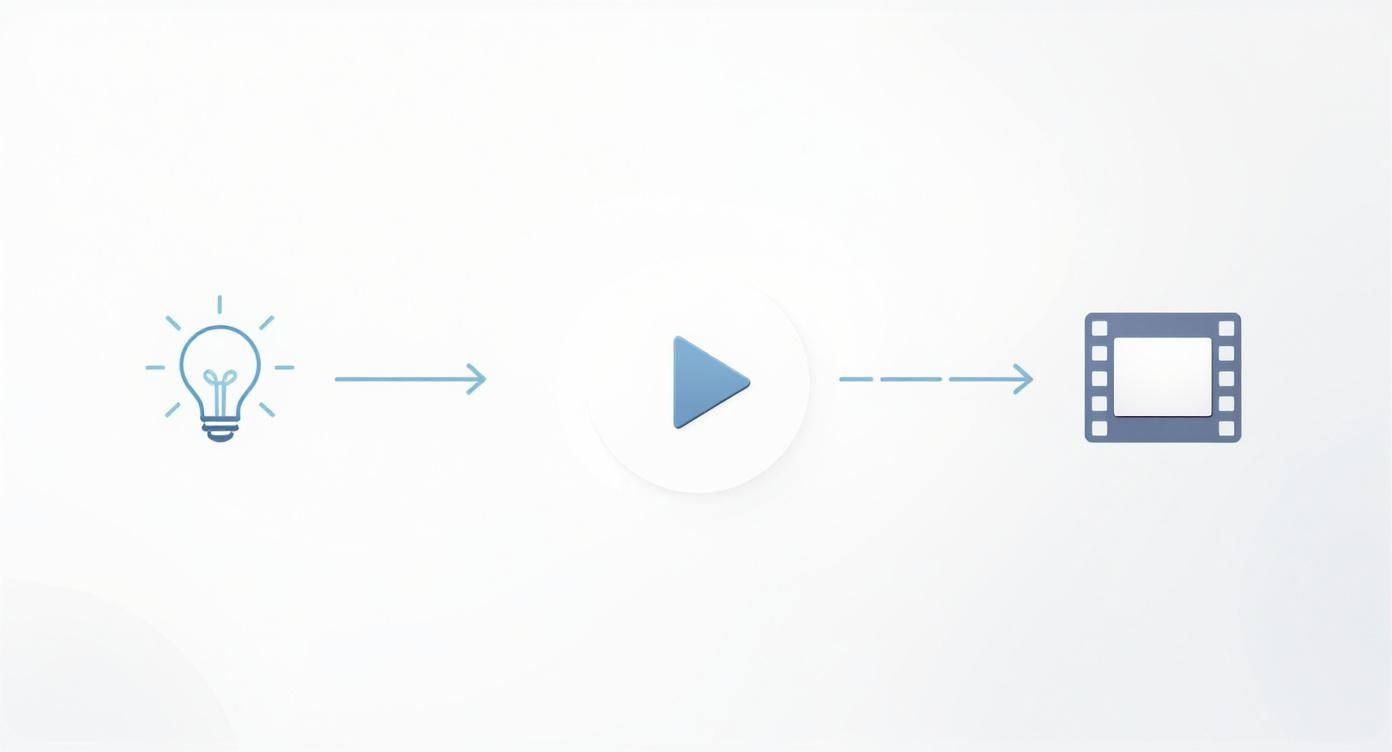
The whole process is pretty simple: you start with an idea, use the generator to create the visuals, and then assemble those pieces into your final storyboard.
This structured approach lets you focus your energy on what really matters—the storytelling.
Define Your Narrative Core
Before you write a single word of a prompt, you need to lock in three core elements. These are the pillars of your storyboard, the foundation that ensures every scene feels like it belongs in the same universe. Nailing these details from the start is the secret to consistency.
- Character Consistency: Who is your story about? Don't just settle for "a man." Get granular. Is he a "weary detective in a rumpled trench coat with a cynical gaze"? That specific description becomes your anchor, something you can reuse in every Sora 2 prompt to keep your character looking the same.
- Setting the Scene: Where is all this happening? "A futuristic city" is way too broad. What about a "rain-slicked cyberpunk alley with glowing holographic ads and steam rising from the grates"? This gives the AI a rich, detailed environment to work with from shot to shot.
- Establishing Tone: What's the mood? Is it suspenseful? Comedic? Inspiring? Words like "ominous shadows," "vibrant morning light," or "fast-paced and energetic" help guide the emotional feel of your video.
By defining these core elements first, you’re basically creating a style guide for your AI. This ensures that even as the action changes, the visual and emotional threads hold together, giving you a much more believable and professional-looking final product.
Choosing Your Starting Point
The saro2.ai generator offers two main ways to get a scene started: you can either begin with a text prompt or use a reference image. Each has its own strengths, and knowing which one to use for the job is a game-changer.
- Text-to-Video for Maximum Creativity: This is your go-to when you have a clear vision in your head but no images to start with. It gives you total creative freedom to build entire worlds just from your words. It's perfect for brainstorming initial concepts or creating completely fantastical scenarios.
- Image-to-Video for Unmatched Control: If you already have a specific character design, a product photo, or a key location you need to feature, this is the way to go. Starting with an image provides a powerful visual anchor for the AI, which dramatically improves consistency—especially for keeping a character's face or a brand's aesthetic the same across multiple scenes. For Sora 2 for ecommerce and product videos, this method is almost always better.
Crafting Prompts for Seamless Scene Progression
This is where your storyboard stops being a random collection of clips and starts telling a real story. The secret to a killer AI-generated video is all in the Sora 2 prompts—they're how you direct the camera, tell your characters what to do, and build a narrative that actually flows. Forget vague ideas; precision is your best friend here.
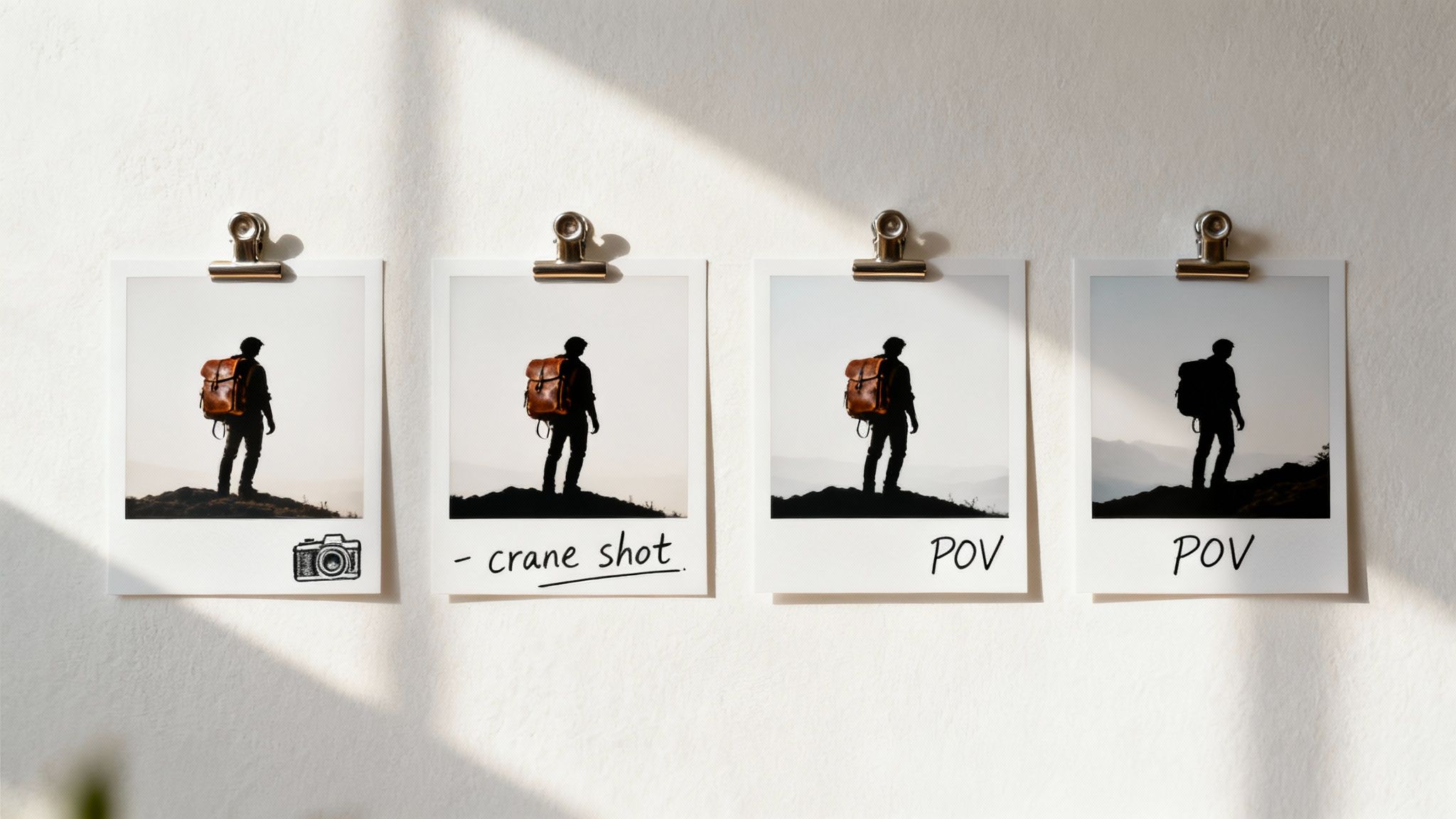
Think of a great prompt as a director's note to their film crew. Instead of just saying, "show a person walking," you'd specify a "crane shot following a determined adventurer with a worn leather pack as they trek across a vast, sun-scorched desert." It's that level of detail that gets you those cinematic, consistent results.
The Anatomy of a Powerful Prompt
To get the most out of a Sora 2 storyboard generator, you need to structure your prompts with a clear hierarchy. It really helps to think like a filmmaker and organize your instructions in a way that guides the AI logically.
I've found that the most effective prompts usually follow this pattern:
- Start with Style and Camera: First, define the overall vibe and camera movement. Using terms like
cinematic,point-of-view shot, ordolly zoomright at the beginning sets the stage perfectly. - Define the Subject and Action: Next, describe who's in the shot and what they're up to. This is where those consistent character descriptions you planned earlier become absolutely essential.
- Detail the Environment: Ground your subject in a specific place. The more vivid you can be with the details, the richer the world in your video will feel.
- Add Atmospheric Elements: Finally, layer on the lighting, mood, and emotion. Words like
golden hour lighting,somber mood, orhigh-energyare the finishing touches that really make a scene pop.
For instance, a weak prompt might just be: "A woman in a city."
A much stronger, structured prompt would look like this: "Cinematic wide shot. A woman with a red coat and a thoughtful expression walks through a neon-lit cyberpunk alley, rain reflecting on the pavement, shallow depth of field."
This methodical approach gives the AI a clear, step-by-step blueprint to build from, which makes a night-and-day difference in the quality of the scenes it generates.
Maintaining Visual Consistency Across Scenes
The absolute key to a believable multi-scene video is consistency. You need your characters and locations to look like they belong in the same universe from the first frame to the last. The trick is to use recurring keywords as anchors.
Think of these keywords as your personal "story bible." If your main character is a determined adventurer with a worn leather pack, you need to use that exact phrase in every single prompt where they appear. The same goes for locations, like a bustling, sun-drenched medieval market.
By locking in these descriptive anchors, you’re basically training the AI on the specific visual DNA of your story. It’s the single most effective way I've found to stop the model from spitting out a different-looking character or a brand-new setting halfway through your video.
OpenAI didn't just build Sora 2 to generate video; they've been pushing it to understand and maintain a consistent world state. It has evolved from basic object permanence to following complex, multi-shot instructions while keeping the reality of the scene intact.
Building Narrative Flow with Prompt Variation
Once you’ve nailed down consistency, the next step is to actually move the story forward. You do this by making small, deliberate changes to your core prompt for each new scene. You keep your character and setting anchors the same, but you switch up the action or the camera angle.
Here's a quick, practical example of how this would work for an e-commerce ad:
- Scene 1 (Hook):
Extreme close-up on a futuristic silver watch on a man's wrist, intricate gears visible, studio lighting. - Scene 2 (Action):
Medium shot of the **same man** wearing the **futuristic silver watch**, confidently striding through a bustling airport terminal. - Scene 3 (Call-to-Action):
Close-up shot of the **man's hand** holding the **futuristic silver watch**, he smiles at the camera, product name appears.
See how the core elements—man and futuristic silver watch—are locked in? But the camera shot and action evolve to tell a quick story. This technique turns a bunch of separate clips into a smooth, dynamic sequence that feels professional and intentional. The saro2.ai generator is built to make this scene-by-scene process incredibly intuitive.
Tailoring Storyboards for Social Media and Ads
Creating a brilliant storyboard is a huge win, but it’s only half the battle. Where that video ends up is what truly determines its success. A beautifully cinematic sequence will completely fall flat on TikTok if it isn't built for the platform's fast-paced, vertical world. Adapting your Sora 2 creations for social media isn't an afterthought—it needs to be baked into your AI video marketing strategy from the very start.
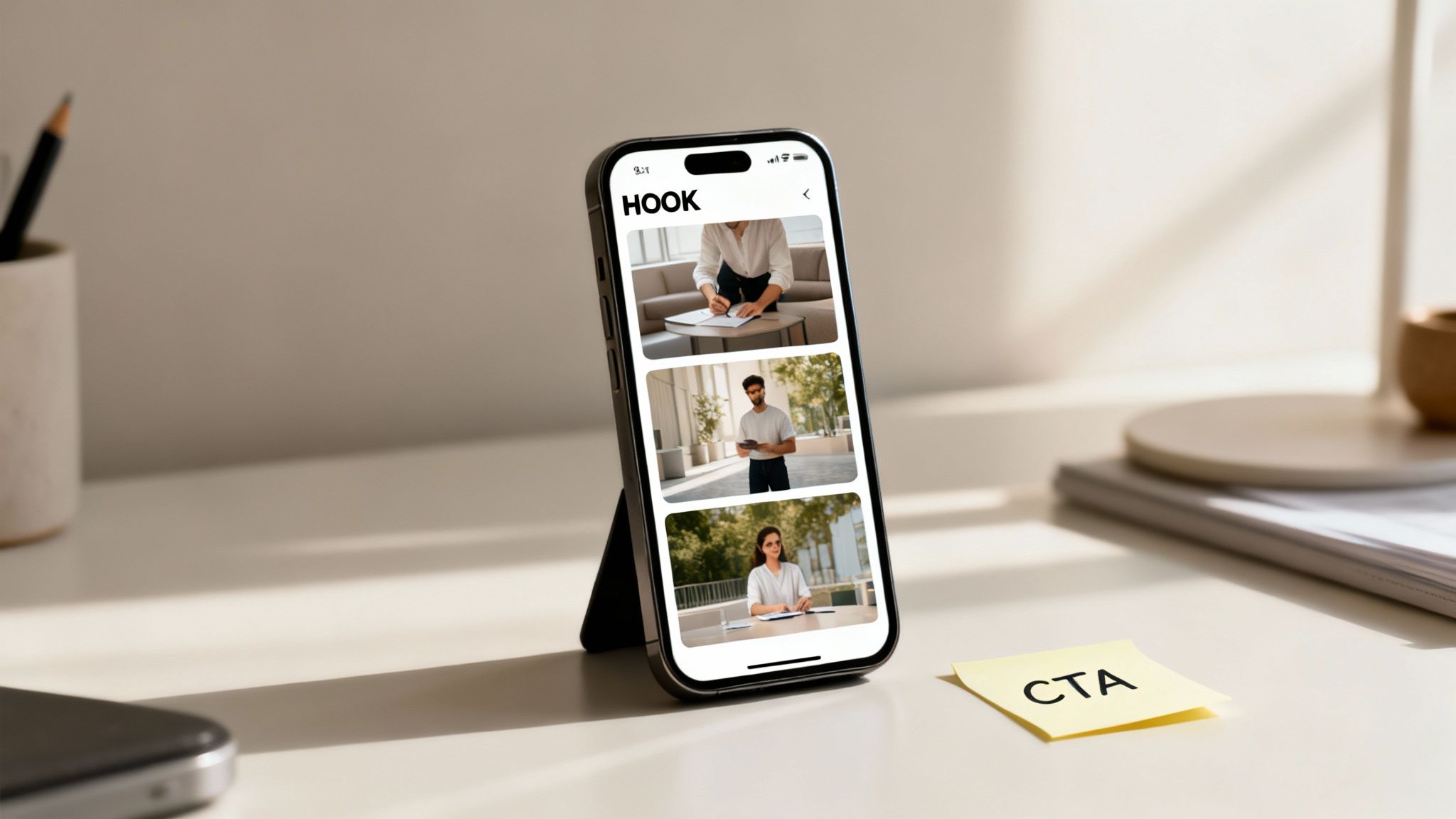
This means you have to think in vertical frames and quick, punchy scenes right from the beginning. For platforms like TikTok, Instagram Reels, and YouTube Shorts, the 9:16 aspect ratio is the law of the land. It fills the entire phone screen, commands the viewer's full attention, and avoids that amateur look of a horizontal video squished into a vertical frame.
Pacing for Short Attention Spans
On these vertical-first platforms, you have less than three seconds to hook someone. Your storyboard has to reflect that urgency. Your very first scene needs to be the most visually arresting, intriguing, or surprising shot you can come up with.
From there, the pace needs to stay rapid. For a typical 15-second ad, a good rule of thumb is to plan for 3-5 distinct scenes. This keeps things moving and prevents the viewer's thumb from instinctively swiping away.
- Scene 1 (The Hook): Go for an extreme close-up, a dramatic action, or a visual that makes someone ask, "What's going on here?"
- Scene 2 (The Buildup): Waste no time introducing the product, person, or main idea in a compelling way.
- Scene 3 (The Payoff): Land your key message or call-to-action with a clear, impactful final shot.
This simple structure helps you get your point across before you lose your audience, which is absolutely critical for both organic posts and paid ads.
Structuring Storyboards for Conversions
When your goal is to drive sales or clicks, your storyboard needs a laser-focused purpose. It's not just about telling a cool story; it’s about guiding the viewer to take a specific action. That means your final scene must be built entirely around your call-to-action (CTA).
The best social media ads feel like native content but have a clear commercial intent. Your Sora 2 storyboard should visually lead the viewer to a conclusion, making the CTA feel like a natural next step rather than an abrupt sales pitch.
There's a reason the AI video generation market is exploding. Valued at USD 554.9 million in 2023, it's on track to hit nearly USD 1.96 billion by 2030. Tools like the saro2.ai storyboard generator let marketers create and A/B test multiple ad versions in minutes—a massive advantage over slow, traditional production. You can read more about the market's growth and Sora 2's role on mpgone.com.
To build a storyboard that actually converts, make sure your final prompts explicitly ask for CTA elements. Think along these lines:
"A hand tapping the 'Shop Now' button on a phone screen""The product displayed clearly on a clean background with text overlay 'Link in Bio'""A character smiling and pointing towards the bottom of the screen"
These kinds of direct visual cues make your ad far more effective. By using AI to quickly generate variations of these final scenes, you can test which CTA visuals connect with your audience and optimize your campaign for maximum impact without blowing your budget.
From Concept to Creation: Real-World Examples
Alright, let's get out of the theoretical and into the practical. The best way to really wrap your head around a Sora 2 storyboard generator is to see it in action. We're going to walk through two classic scenarios: an e-commerce brand building a quick TikTok ad and a creator crafting a short narrative piece.
Think of these as playbooks. I’ll show you the exact Sora 2 prompts and the thinking behind them, so you can see how a simple idea evolves into a full-fledged, multi-scene video. You can easily adapt these workflows for your own projects, whether you're selling a product or just telling a cool story.
Ecommerce Brand TikTok Ad
Let's say a Shopify store is dropping a new line of rugged, waterproof smartwatches. They need a fast, punchy 15-second TikTok ad that stops the scroll and gets people to their site. This is a perfect use case for Sora 2 for ecommerce. The goal is a classic three-part structure: the hook, the product in action, and the call-to-action.
First, you have to define your core visual elements. This is key for consistency.
- Character:
A rugged adventurer with a confident smile - Product:
A sleek, black waterproof smartwatch with a glowing face - Setting:
A misty, ancient forest with towering trees
With these established, you can build out the storyboard scene by scene.
Scene 1: The Hook (3 seconds) The opening shot has one job: make them stop. We need to show the core feature—waterproofing—in a visually interesting way.
- Prompt:
Extreme close-up, point-of-view shot. A rugged adventurer with a confident smile plunges his arm into a rushing waterfall. A sleek, black waterproof smartwatch with a glowing face is visible underwater.
Scene 2: The Showcase (7 seconds) Now, we connect the product to the lifestyle. It’s not just a watch; it's a tool for adventure.
- Prompt:
Dynamic medium shot. The same rugged adventurer jogs through a misty, ancient forest, checking his route on the sleek, black waterproof smartwatch. Sunlight filters through the canopy.
Scene 3: The Call-to-Action (5 seconds) Finally, a clean shot to present the product and tell people what to do next. No ambiguity here.
- Prompt:
Clean product shot. The sleek, black waterproof smartwatch is displayed against a dark, rocky background. Text overlay appears: 'Adventure-Proof. Shop Now.'
In just three prompts, you've created a complete story perfect for social media. By repeating keywords like "rugged adventurer" and "sleek, black waterproof smartwatch," you're coaching the AI to maintain visual consistency across the cuts.
Pro Tip: For e-commerce, I always recommend starting with an image reference of your actual product if you can. It gives the AI a solid visual anchor and leads to a much more accurate depiction in every scene.
Content Creator Narrative Short
Now, let's switch gears to a content creator. They want to make a short, moody video for YouTube about an artist finding inspiration after a creative block. The vibe is contemplative and ultimately hopeful.
Here’s a simple but effective way they could structure this story using the saro2.ai generator.
- Scene 1 (The Struggle):
Cinematic close-up. A young female artist with tired eyes sits in a dimly lit studio, staring at a blank canvas. The mood is somber, with soft, cool lighting. - Scene 2 (The Shift):
Wide shot. The same young female artist stands on a deserted city bridge at dawn, looking out at the skyline. The sky is filled with soft pink and orange hues. - Scene 3 (The Breakthrough):
Medium shot. The artist is back in her studio, now bathed in warm morning light. She smiles faintly as she confidently applies the first brushstroke to the canvas.
This sequence builds a beautiful emotional arc in just three shots. The storytelling isn't just in the action; it's conveyed through the dramatic shifts in lighting and setting, guiding the viewer from the artist's internal struggle to her moment of inspiration.
Common Questions About AI Storyboarding
Even with the best planning, you'll probably hit a few snags the first time you use a Sora 2 style model. Getting ahead of these common hurdles makes the whole process feel less like a guessing game and more like actual directing.
Let's break down some of the most frequent questions that pop up.
How Do I Keep a Character Consistent?
This is the big one. Nothing breaks the illusion of a story faster than a character who looks different from one shot to the next. The best trick I've found is to get hyper-specific with your Sora 2 prompts and repeat them in every single prompt.
Don't just say "a woman." Instead, describe her as "a young female artist with tired eyes and a blue denim jacket." Be relentless with those details.
For even better results, lean on the image-to-video feature. Create a perfect still image of your character first. Then, use that same image as the starting point for every video scene that follows. This gives the AI a solid visual anchor, which dramatically improves consistency from shot to shot.
Using a reference image is like giving the AI a character sheet. It stops the model from guessing about key facial features or clothing, which is a common weak spot for many Sora 2 alternatives.
Can the Sora 2 Storyboard Generator Create Specific Camera Moves?
Absolutely, and this is where you can really start to feel like a filmmaker. You can direct the camera by embedding cinematic terms right into your prompts. This is how you go from static, boring shots to a sequence that feels dynamic and intentional.
Try experimenting with different camera commands to see how they change the mood:
dolly zoom in on the character’s faceworks wonders for building tension.crane shot revealing the cityscapeis perfect for establishing a grand, epic scale.handheld shot following the dog through the parkcreates a more raw, documentary-style vibe.
What Is the Best Way to Structure Prompts for a Story Arc?
When you're telling a full story, you need to think like a screenwriter. Structure your prompts to follow a classic three-act arc. Each prompt should represent a key moment that moves the narrative forward.
Here’s a simple way to map it out:
- Scene 1 (Inception): Use your first prompt to set the scene and introduce who we're following.
- Scene 2 (Confrontation): The middle prompts are for the action, the conflict, or the big turning point.
- Scene 3 (Resolution): Your final prompts should tie everything together and give the story a satisfying conclusion.
Ready to stop sketching and start directing? The saro2.ai Sora 2 video generator gives you the tools to build cinematic storyboards in minutes. Start creating your first multi-scene video today at saro2.ai.