Sora 2 Cinematic Video Generator: Your Quick Guide to Professional AI Video
Master the sora 2 cinematic video generator with proven techniques to craft stunning AI videos from text, images, and storyboards.
Welcome to the new era of video production. Forget massive studio budgets or years of technical training—creating stunning, film-quality visuals is now more accessible than ever. With a powerful Sora 2 cinematic video generator, you can turn a simple text prompt, a single image, or a multi-scene storyboard into a professional-grade video.
This guide will show you exactly how to leverage Sora 2 text-to-video technology, breaking down the old barriers of expensive gear and complicated editing software.
The Future of AI Cinematic Video Creation

The leap from a simple idea to a fully-realized cinematic video is what’s completely shaking up content creation. For decades, making a high-quality video was a logistical nightmare. You had to find actors, scout locations, hire a film crew, and then brace yourself for endless hours of post-production work. The whole process wasn't just slow; it was prohibitively expensive for most small businesses and solo creators.
That's where a Sora 2 video generator like Saro2.ai comes in. This technology is essentially your personal film crew, art director, and editor all wrapped into one clean platform. It’s built to understand your creative vision from Sora 2 prompts and translate it into motion, one frame at a time.
High-Quality Production for Everyone
The real magic here is accessibility. It doesn't matter if you're an indie filmmaker storyboarding your passion project or a marketer trying to create a viral TikTok ad—the creative doors are wide open. You can now produce ambitious visual stories without any formal background in cinematography or special effects.
This isn't just a convenient shortcut; it has serious business implications. AI video marketing strategies are becoming essential. In 2023, the global AI video market hit a valuation of $42 billion, a clear sign of how quickly companies are jumping on board.
Your Partner in Visual Storytelling
Think of a Sora 2 style model as a creative collaborator. It empowers you to test out concepts that would have been completely impractical before, whether you're dreaming up fantastical landscapes or crafting hyper-realistic product videos.
As AI video generation matures, it pays to explore different models and Sora 2 alternatives. For instance, a practical guide to Wan2.2 GGUF video generation gives you a sense of just how diverse the toolset is becoming.
The real power of a Sora 2 cinematic video generator isn't just in making videos. It's in rapidly testing ideas, visualizing concepts, and producing content at a scale that was once unimaginable. It gives you the freedom to fail, iterate, and succeed faster than ever.
In this guide, we'll get straight to the practical steps you need to make this technology work for you. We’re moving past the theory and into actionable techniques for writing Sora 2 prompts, building storyboards, and optimizing your videos for specific platforms. Let’s turn your ideas into visuals that captivate.
Crafting Sora 2 Prompts That Direct the AI
The real magic behind any Sora 2 cinematic video generator isn't the AI itself—it's you. The quality of your prompts is what separates a generic, wobbly clip from a truly stunning piece of video. This is where you stop being a user and start being a director.
Think of it like this: you wouldn't walk onto a film set and just tell the crew to "film a car." You'd give them the model, the color, the speed, the location, the time of day, and exactly how you want the camera to capture it. That’s the level of detail we need to bring to our Sora 2 prompts.
The Anatomy of a Powerful Prompt
A great prompt for Sora 2 text-to-video is really just a recipe with a few key ingredients. The more of these you include, the less guesswork the AI has to do, and the closer the final video will be to what you imagined.
- Subject: Get specific. Don’t just say "a woman." Try "a young woman with curly auburn hair, wearing a vintage denim jacket."
- Action: Give that subject something to do. "Walking" is okay, but "strolling thoughtfully along a rain-slicked cobblestone street" tells a story.
- Environment: Paint a picture of the world around them. Instead of "a forest," describe it as "a dense, misty redwood forest at dawn, with sunbeams breaking through the canopy."
When you weave these details together, you're building a rich, cohesive scene that the AI can understand with far more accuracy. The more vivid the picture you paint with your words, the better the result will be.
A powerful Sora 2 prompt doesn't just describe what's in the scene; it dictates the mood and feeling of the entire video. It’s the difference between a random clip and a piece of cinematic art.
Controlling the Camera and Style
If you want your video to feel genuinely cinematic, you have to take control of the virtual camera. This is the secret sauce. By using actual filmmaking terms, you can guide the AI's "eye" and turn a static image into a dynamic, moving scene.
Start sprinkling in specific camera instructions like these:
- Shot Type: Wide shot, medium close-up, extreme close-up
- Camera Angle: Low angle shot, high angle shot, eye-level
- Camera Movement: Dolly zoom, crane shot up, slow pan left, handheld tracking shot
Just as important is defining the overall look and feel. The artistic style and lighting are what set the entire tone. For instance, adding "cinematic lighting, golden hour" will give you that warm, dreamy glow. On the other hand, "moody neon lighting, cyberpunk aesthetic" will create something else entirely.
Learning to write a solid prompt is the core skill here, and it's not just for video. The same logic applies when you're generating AI text sound effects. It all comes down to translating your creative vision into clear, precise instructions a machine can follow.
By combining all these elements—detailed subjects, actions, environments, camera work, and artistic styles—you're handing the Sora 2 generator a complete blueprint. This is how you unlock its true potential and start creating visuals that are not just impressive, but perfectly aligned with your story.
Building Narratives with the Sora 2 Storyboard Generator
A single, stunning shot from an AI video generator is cool, but it's not a story. To really hook an audience and get them to take action, you need to weave those shots into a cohesive narrative. This is where you graduate from simply making clips to actually directing a story, and the Sora 2 storyboard generator is the tool that gets you there.
Instead of trying to cram a whole story into one massive, complicated prompt, the storyboard generator lets you think like a filmmaker. You map out your narrative scene by scene, giving each moment its own focused and detailed prompt. This is how you build a video with a beginning, middle, and end.
Planning Your Multi-Scene Video
Before you even think about writing a prompt, step back. Grab a notebook or open a blank document and outline the story you want to tell. For something like a short product ad, a classic three-act structure is surprisingly effective and easy to follow.
- The Hook (Scene 1): Your first shot needs to grab attention immediately. Maybe it's a relatable problem or just a visually arresting moment that makes someone stop scrolling.
- The Solution (Scene 2): Now, bring in your product or service. Frame it as the hero that solves the problem you just introduced.
- The Call to Action (Scene 3): End by showing the happy outcome. What does life look like after the solution? Then, tell the viewer exactly what to do next.
This simple planning process is crucial. It gives your video purpose and prevents the AI from spitting out a random collection of beautiful but disconnected clips.
For each scene you plan, you'll need a solid prompt. The best prompts are a clear mix of three core ingredients: the subject, the action, and the style.
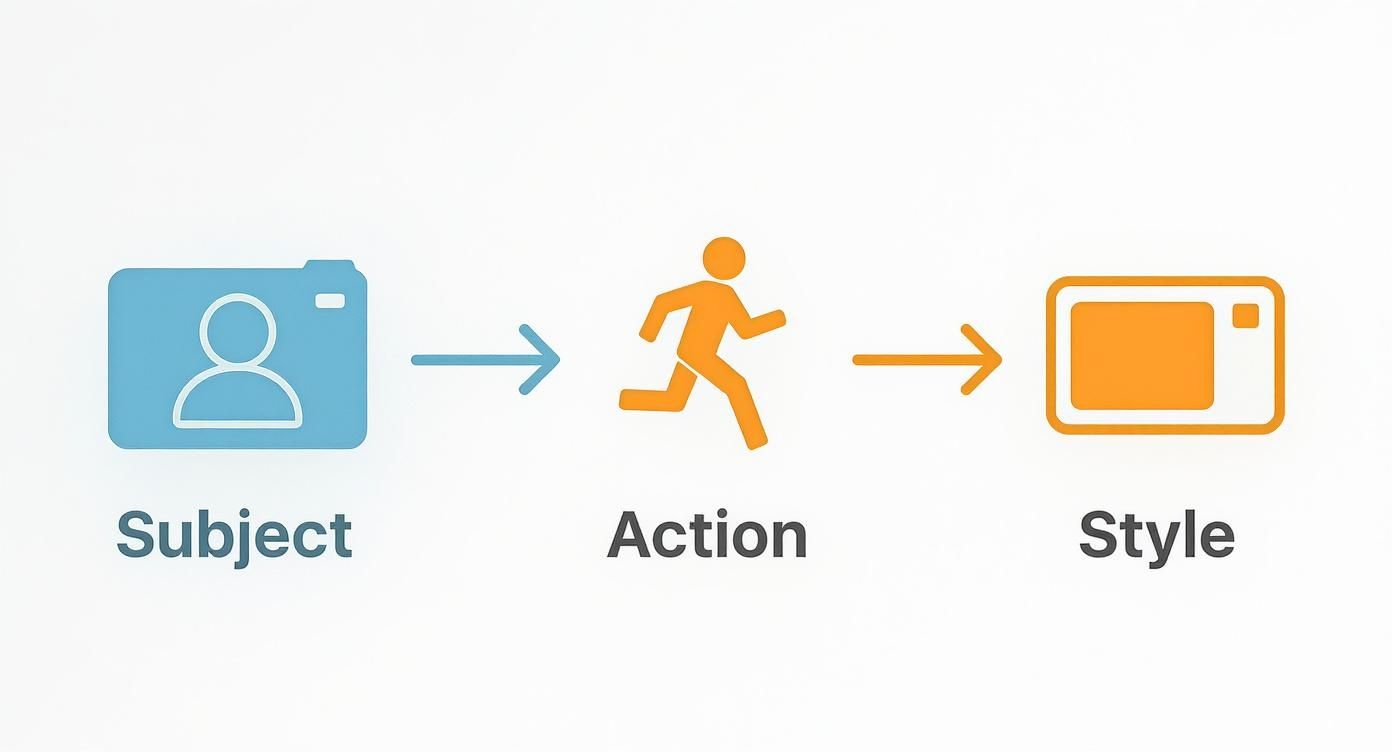
Giving the AI clear instructions on these three elements for every single scene is the key to getting the results you want.
To make this even easier, you can use a simple planning table. This framework helps you organize your thoughts for each scene, ensuring you've covered all the bases before you start generating.
Storyboard Scene Planning Template
| Scene Number | Core Action or Focus | Detailed Prompt (Camera, Lighting, Style) | Desired Duration in Seconds |
|---|---|---|---|
| 1 | Introduce the character feeling overwhelmed by a messy desk. | Overhead shot, soft morning light, a young professional looks stressed at a cluttered desk, realistic, 4K. | 3 |
| 2 | Character uses our productivity app to organize their tasks. | Close-up on smartphone screen showing the app, then a wider shot of the character smiling, clean and minimalist style. | 4 |
| 3 | A time-lapse of the desk becoming perfectly organized, ending with a clean space. | Fast-paced time-lapse, bright and energetic lighting, final shot is a satisfyingly clean desk, cinematic feel. | 3 |
This structure forces you to think through the narrative flow and technical details ahead of time, which saves a ton of frustration later.
Maintaining Consistency Across Scenes
Here’s the biggest hurdle with multi-scene AI video: consistency. It’s incredibly frustrating when your main character’s hairstyle changes mid-video or the warm, sunny lighting suddenly turns cool and overcast between shots.
The solution is all about repetition and detail in your prompts.
The secret to a professional-feeling AI video isn’t just great individual shots, but the invisible thread of consistency that ties them all together. Your Sora 2 prompts are that thread.
To create that thread, think in terms of a "master prompt." Define your non-negotiable elements—the character's appearance, the location, the overall aesthetic—and then copy-paste that foundation into the prompt for every scene. The only thing you should change from one prompt to the next is the specific action or camera angle.
Let's say your Scene 1 prompt is:
cinematic shot, a young woman with a sleek black bob haircut and a red trench coat walking through a rainy neon-lit Tokyo street, hyperrealistic, 8k
For Scene 2, you wouldn’t start from scratch. You’d build on the first one:
cinematic shot, a young woman with a sleek black bob haircut and a red trench coat **stops to look at a shop window**, rainy neon-lit Tokyo street, hyperrealistic, 8k
See how almost everything stays the same? We only changed the action. This repetition acts as an anchor for the AI, dramatically improving the chances of maintaining visual continuity.
When you use the Sora 2 storyboard generator from Saro2.ai, you can build out these scenes methodically, review them together, and ensure your story flows perfectly from one shot to the next. That’s how you get a polished, professional video that looks like it was made by a single, coherent vision.
Using Sora 2 for Ecommerce and TikTok Ads
Making a beautiful video is one thing, but making one that actually sells on a Shopify store or stops the scroll on TikTok is a whole different ball game. The old rules of cinematic storytelling get thrown out the window here.
On platforms like these, you're not just fighting for attention—you're fighting against the thumb. You have less than three seconds to give someone a reason not to scroll past. Your entire video strategy needs to be built around a powerful, immediate hook that grabs them instantly.
This is exactly where a Sora 2 cinematic video generator becomes a secret weapon for marketers. Forget spending days shooting and editing a single concept. Now you can spin up a dozen variations, each with a completely different opening hook, in the time it takes to grab a coffee. This is how you use Sora 2 for TikTok ads and other short-form platforms effectively.
How to Write Prompts for High-Engagement Ads
To get videos that actually perform, you have to write prompts built for speed and impact. Ditch the slow, panning landscape shots and think in terms of quick cuts, high energy, and visually satisfying moments.
Here are a few things I always keep in mind:
- Go Vertical: Always, always start your prompt with
9:16 aspect ratioorvertical video. This is non-negotiable for mobile-first platforms. - Nail the 3-Second Hook: The prompt for your first scene is the most important one. I use phrases like
dynamic fast-paced shot,extreme close-up revealing, orvisually satisfying slow-motion dropto create that initial "wow" factor. - Create a Perfect Loop: On platforms that auto-replay videos, a seamless loop is pure gold for watch time. Plan your final scene to mirror your opening shot and just add
seamless loopto your prompt.
A/B Testing on a Whole New Level
The real game-changer here isn't just making videos; it's the ability to A/B test your creative without torching your budget. You can easily generate five different versions of an ad—one with a different product angle, another with a new color palette, a third with an alternative opening—and see what sticks.
You're no longer guessing what might work. By generating and testing multiple video concepts, you're letting the audience's clicks and engagement tell you what's a winner. It turns ad creation from an art into a science.
And this isn't just for ads. Small and mid-sized businesses use these tools for creating product videos and report significant increases in engagement. Marketing teams can now run fresh campaigns every single week, not just once a month.
Using a tool like the Saro2.ai storyboard generator, your workflow becomes incredibly simple. Build out a few different versions of your ad, export them, and run them on a small budget. In a day or two, you'll know exactly which one is getting the best engagement. Put your real ad spend behind that proven winner, and watch the results roll in.
Advanced Techniques and Troubleshooting
Even with killer prompts and a perfect storyboard, you're going to hit some bumps in the road. It just happens. This is where a few advanced tricks and a bit of troubleshooting can take a video from "pretty good" to truly impressive. Learning how to navigate these challenges is really what separates the beginners from the pros.
One of the most common headaches is character consistency. I’m sure you’ve seen it—your hero's jacket suddenly changes from blue to green between shots, or their hairstyle randomly morphs. Another classic issue is wonky physics, like a ball bouncing way too high or fabric that just doesn't hang right. These little things can totally shatter the illusion.
But don't let it frustrate you. Think of your first video generation as a rough draft. Your role is to polish it and guide the AI toward that final, perfect cut.
Fine-Tuning with Iterative Prompts
When something in your video is off, the best fix is almost always to tweak your prompt and run it again. This back-and-forth process is how you wrestle control back from the machine. Let’s say your main character’s face looks a little different in the second scene. Jump back to that prompt and add more detail.
Instead of a generic "a woman with brown hair," get specific. Try something like, "a woman with warm chestnut brown hair in a messy bun, with light freckles across her nose." The more unique and permanent details you lock in, the better the AI’s "memory" gets from scene to scene.
Sometimes, the issue isn't what's in the shot, but what shouldn't be there. That's when you bring in negative prompts.
Troubleshooting with AI isn’t about fixing a broken machine. It’s about having a better conversation with it. Clearer, more specific instructions lead to clearer, more specific results.
By telling the AI what to leave out, you can clean up your visuals in a big way. For instance, if you're creating a medieval battle and a sedan keeps photobombing the background, you can add a negative prompt like (--no cars, modern buildings) to banish it.
Combining Inputs for Unique Effects
The real magic starts when you begin mixing and matching the tools inside a Sora 2 cinematic video generator. Don’t treat text-to-video and image-to-video as separate features. They’re incredibly powerful when you use them together.
Here’s a workflow I use all the time for creating unique Sora 2 ecommerce and product videos:
- Start with an Image: First, get a clean, high-quality photo of your product against a simple background.
- Use Image-to-Video: Upload that photo and use a prompt to bring it to life. Something simple like,
cinematic slow zoom out, studio lighting, revealing the product on a pedestal. - Transition to Text-to-Video: Now, for the next scene in your storyboard, switch entirely to a text prompt. Describe someone actually using the product in a lifestyle setting. Just make sure to repeat the product's key visual descriptors to maintain consistency.
This hybrid method gives you the best of both worlds. You get the pixel-perfect accuracy of your product from the initial image, combined with the total creative freedom of building scenes from text. You can play around with these techniques and other advanced features over at the Saro2.ai platform. It's all about using every tool in the box to get past creative hurdles and make something that stands out.
Got Questions? We've Got Answers
You're not alone. As you get the hang of creating videos with a Sora 2 video generator, a few common questions tend to pop up. Here are some quick, practical answers to get you past those hurdles and back to creating.
How Do I Keep My Character Looking the Same in Every Scene?
Ah, the classic character consistency problem. It's one of the trickiest parts of AI video, but you can absolutely nail it. The secret is to be relentlessly specific and repeat yourself in every single Sora 2 prompt.
Don't just say "a woman." Instead, lock in the details: "a woman with fiery red hair in a high ponytail, wearing a black leather jacket." Copy and paste that exact description into the prompt for each scene. This repetition acts like a beacon for the AI, reminding it what to create.
Want to take it a step further? Try this workflow:
- Start with an Image: If you have a reference image of your character, use it for the very first scene with an image-to-video prompt. This gives the AI a strong visual foundation.
- Name Your Character: It sounds simple, but giving your character a unique name in the prompt (e.g., "Anya, a woman with fiery red hair...") can sometimes help the model track them across different shots.
- Tweak and Regenerate: If a scene comes out a little wonky, just regenerate it. Add a bit more descriptive detail to the prompt and give it another shot. Patience pays off.
What Are the Best Export Settings for TikTok and Instagram?
When you're making videos for platforms like TikTok or Instagram, you have to think vertical from the very beginning. Your export settings are just as crucial as the content itself.
Make sure you’re creating and exporting in a 9:16 aspect ratio. The ideal resolution is 1080x1920 pixels. This is the native format for these platforms, so your video will look clean, fill the whole screen, and avoid those ugly black bars.
For that perfect sweet spot between quality and file size, export as an MP4 using the H.264 codec. I usually aim for a frame rate of 30 FPS and a bitrate between 5-8 Mbps. This keeps the video looking sharp without making viewers wait forever for it to load.
Can I Actually Use These Videos for Client Ads?
Absolutely. That's one of the best things about a powerful Sora 2 cinematic video generator—the output is professional enough for real commercial work. People are using these tools every day for client ad campaigns and product videos on platforms like Shopify.
The key is to double-check the terms of service for the specific platform you're using. Most modern AI tools give you full commercial rights, meaning you own the final video and can use it however you see fit for your business.
That said, the responsibility is still on you to make sure the final video doesn't step on any existing copyrights or trademarks. Before you push a client's campaign live, it’s always smart to give the licensing agreement one last look to be certain you have all the necessary permissions.
Ready to bring your own cinematic stories to life? With Saro2.ai, you can create stunning Sora 2 video examples from text, images, or a full storyboard without any waitlists or watermarks. Start creating at saro2.ai.