Your Guide to the Sora 2 AI Video Generation Tool
Explore the Sora 2 animation generator with our guide. Learn to craft expert prompts, build practical workflows, and create stunning AI videos from text.
A Sora 2 animation generator is essentially a text-to-video AI model, but calling it just that feels like an understatement. Think of it as a tool that can whip up incredibly realistic, cinematic video clips from nothing more than a few lines of text. This isn't just a small step forward from older AI video tech; it's a massive jump. With Sora 2 AI video generation, we're now seeing longer, more cohesive scenes that show a genuine understanding of real-world physics and even subtle emotions.
A Whole New Way to Create Video
The arrival of the Sora 2 video generator is shaking up how we think about digital content. For years, producing high-quality video meant you needed a big budget, expensive gear, and a whole team of skilled people. That barrier is crumbling. Now, if you have an idea, you can bring it to life with a simple text prompt.
This technology has moved past the quirky, often disconnected clips we saw from earlier models. Instead, it generates smooth, longer videos that keep characters consistent and follow a logical narrative. This is a game-changer for creators, marketers, and anyone who needs compelling visuals without the traditional hassle and cost. To see how this fits into the bigger picture, it's worth checking out other AI video tools to get a feel for the rapidly advancing field.
What Makes This Tech a Big Deal?
What really sets the Sora 2 text-to-video model apart is how well it understands language and the physical world. If you use a prompt like "a golden retriever puppy playing in the snow," it doesn't just spit out a generic animation. It gets the details right—the way the snow kicks up under the puppy's paws or how its fur fluffs up in the cold. It’s this attention to realism that makes Sora 2 video examples so much more believable and engaging.
From a practical standpoint, this opens up some incredible doors:
- Sora 2 for TikTok Ads: You can now create stunning, scroll-stopping videos that grab attention instantly, all without hiring a film crew.
- Sora 2 for Ecommerce and Product Videos: Imagine showing your products in dynamic, real-life settings. It helps customers see the item in their world, not just on a white background.
- Sora 2 Storyboard Generator: You can build out multi-scene storyboards for short films or creative projects, and the AI will maintain a consistent style and character design from one shot to the next.
The real power here is the ability to turn an abstract idea in your head into a polished, high-quality video. It lets you experiment and refine your vision without the massive time and money sink of traditional production.
At the end of the day, a Sora 2 animation generator is like having a creative co-pilot. It takes your vision and translates it into a video you can use right away. This levels the playing field, allowing small businesses and solo creators to produce captivating, narrative-driven content that can compete with what the big studios are putting out.
Your First Steps From Setup to Animation
Jumping into a powerful new tool can feel like a big commitment, but getting started with a Sora 2 animation generator like Saro2.ai is surprisingly straightforward. The old days of invite-only waitlists are gone. Now, you can register and be ready to create in just a couple of minutes.
Once you’re in, you’ll land on the main dashboard. It's built to be clean and simple, so you won't get lost in a sea of options. The most important part is the prompt bar—that's where the magic happens. You'll also spot your project gallery, where everything you make is saved, and different modes like text-to-video and image-to-video.
Navigating the Core Workspace
Before you go wild with your first prompt, it's worth taking a second to get familiar with the key settings. These are the dials and knobs that shape your final animation, and they're usually right next to the prompt bar for easy access. Learning how to use Sora 2 style models starts here.
Here are the big ones you'll want to check first:
- Aspect Ratio: This is just the shape of your video. For TikTok ads or Instagram Reels, 9:16 (vertical) is what you need. For something more cinematic, stick with the standard 16:9 (horizontal).
- Video Style: This is a game-changer. You can pick from styles like "Photorealistic," "Cinematic," "Anime," or "Digital Art," and this one click completely changes the entire vibe of your output.
- Video Duration: How long do you want the clip to be? You can always string scenes together later for a longer story. When you're just starting out, 5-10 second clips are perfect for testing ideas without waiting too long.
Your first project doesn't have to be a masterpiece. The real goal is just to get a feel for the controls. Try a simple prompt and then generate it again with a different style or aspect ratio. Playing around like this is the fastest way to learn what works.
Launching Your First Animation Project
Got your settings dialed in? Great, it’s time to create. Just type a clear, descriptive sentence into the prompt bar.
Try something simple and specific, like, "A close-up shot of a steaming cup of coffee on a wooden table, with soft morning light." Hit "Generate," and the AI will get to work.
That simple process is what makes these tools so potent. It's also why the generative AI animation market is exploding—it’s projected to grow from $2.1 billion in 2024 to $15.9 billion by 2030. Tools like this are putting high-quality creation into everyone's hands. If you're curious about the broader impact, you can read more about how AI is shaping AI motion graphics.
This workflow lets you test, refine your prompts, and produce incredible visuals without ever touching traditional animation or video editing software.
Crafting Sora 2 Prompts That Bring Your Vision to Life
The real magic behind a Sora 2 animation generator isn't buried in some complex setting; it's all about the words you feed it. If you type in "a dog running," you'll get exactly that—a generic, forgettable video. But a carefully constructed Sora 2 prompt? That's your director's script, giving the AI the precise instructions it needs to build something extraordinary.
Think like a cinematographer. Instead of just stating the basics, you need to start layering in the details that bring a scene to life. This means going beyond the "who" and "what" to define the "where," "how," and even the "why" of your animation.
The Anatomy of a Powerful Prompt
A truly effective Sora 2 prompt is a cocktail of descriptive elements. Vague instructions will always lead to muddled, unpredictable results. Specificity, on the other hand, is your superpower. To get those lifelike animations you're after, you have to give the AI a rich vocabulary of visual cues.
Let's break down the core components you should always consider:
- A Detailed Subject: Don't just ask for "a woman." Describe her. Is she "a young woman with curly red hair, wearing a vintage leather jacket and a confident smile"?
- Powerful Verbs: The action word sets the entire tone. "Walking" is fine, but "strolling leisurely," "sprinting urgently," or "shuffling tiredly" tells a much bigger story.
- A Specific Setting: Ground your scene in a tangible place. "A neon-lit Tokyo alleyway at night, rain slicking the pavement" is worlds away from just "a city street."
The gap between an amateur animation and a professional-looking one often closes with just a few extra details. When you specify camera angles, lighting, and artistic style, you’re essentially programming the AI to match the cinematic vision already playing in your head.
Directing the AI with Cinematic Language
To really take your work to the next level, you need to start speaking the language of film. Weaving camera and lighting terminology into your Sora 2 prompts gives you an incredible amount of control over the final look and feel of your animation.
This technology represents a huge leap in text-to-video AI. The ability to generate longer clips at high resolution, complete with synchronized audio, opened up new possibilities. This makes detailed, cinematic prompting more crucial—and more rewarding—than ever, especially when compared to earlier models from companies like OpenAI's.
Here are a few terms to get you started:
- Camera Shots: Try specifying an "extreme close-up," a sweeping "crane shot," a dramatic "dolly zoom," or an off-kilter "Dutch angle" to guide the virtual camera.
- Lighting: Use phrases like "cinematic lighting," "golden hour," "dramatic backlighting," or "soft, diffused light" to instantly establish a mood.
- Artistic Style: You can even lean on famous aesthetics. Adding "in the style of Studio Ghibli" or "like a Wes Anderson film" gives the AI a powerful visual shortcut to understand what you want.
This detailed approach isn't unique to video; it's a core principle of generative AI. For those exploring other ways to turn words into motion, understanding Script to Video AI content creation can offer valuable insights into translating narrative ideas into compelling visuals. By chaining these highly detailed prompts together, you can start building multi-scene storyboards with a consistent look and feel across your entire project.
Sora 2 Animation Prompt Templates
To give you a head start, here are a few Sora 2 prompt templates based on common use cases. Think of these as a starting point—mix, match, and modify them to fit your specific vision.
| Use Case | Prompt Template Example |
|---|---|
| Sora 2 for TikTok Ads | A 25-year-old woman with a joyful expression unboxes a sleek, white skincare product. Extreme close-up on the product's texture. Bright, clean lighting. Modern, minimalist apartment background. Upbeat, trendy music. |
| Sora 2 for Ecommerce | A high-quality leather wallet being opened and closed by a man's hands. Macro shot showing the detailed stitching. Soft, natural lighting against a dark, rustic wooden table. Slow, deliberate motion. |
| Cinematic Story | A lone astronaut slowly walks across the desolate, red-orange surface of Mars. The Earth is a small, blue dot in the black sky. Wide shot, dramatic backlighting from a distant sun. Style of Blade Runner 2049. |
| Explainer Video | A friendly, animated robot character gestures towards a floating, holographic chart showing upward-trending data. Clean, white background. Soft, studio lighting. Simple, engaging, corporate animation style. |
These Sora 2 video examples show how combining subject, action, setting, and cinematic direction creates a complete scene. The more specific you are, the less guesswork the AI has to do, and the closer the final animation will be to what you imagined.
Putting Your Sora 2 Prompts to Work: Practical Workflows
Knowing how to write a good prompt is one thing, but getting tangible results for your business is the real game. It’s time to build repeatable AI video marketing strategies using a Sora 2 animation generator like Saro2.ai. These frameworks create high-impact video content for specific goals.
Whether you're chasing a viral hit on TikTok or trying to boost sales on your Shopify store, having a structured approach saves time and ensures the final video connects with your audience.
Let's walk through a few battle-tested workflows.
Crafting a Scroll-Stopping TikTok Ad
On TikTok, you have maybe three seconds to stop someone from scrolling. That means your video has to be a visual gut-punch from the first frame. This workflow is all about speed, eye-popping aesthetics, and a clear call-to-action, making it a perfect use case for Sora 2 for TikTok ads.
Before I even think about the prompt, I lock in these settings:
- Aspect Ratio: It's always 9:16. No exceptions. You need that native, full-screen feel.
- Pacing: Your prompt has to scream energy. I use terms like "quick cuts," "energetic motion," or "sudden transformation" to get the AI to pick up the pace.
- Style: Go for a style that pops off the screen. "Vibrant animation," "hyperrealistic," or "glowing neon aesthetic" are usually safe bets for grabbing attention.
My Pro Tip: Kick off your prompt with a jarring or wildly intriguing action. Don't start with a slow pan. Try something like, "An extreme close-up of a sneaker bursting through a wall of water, immediately transitioning to a smiling user." It grabs them by the eyeballs.
The whole idea is to create a simple, repeatable structure for your prompts. This diagram breaks down how I think about it: Subject, Action, and Style.
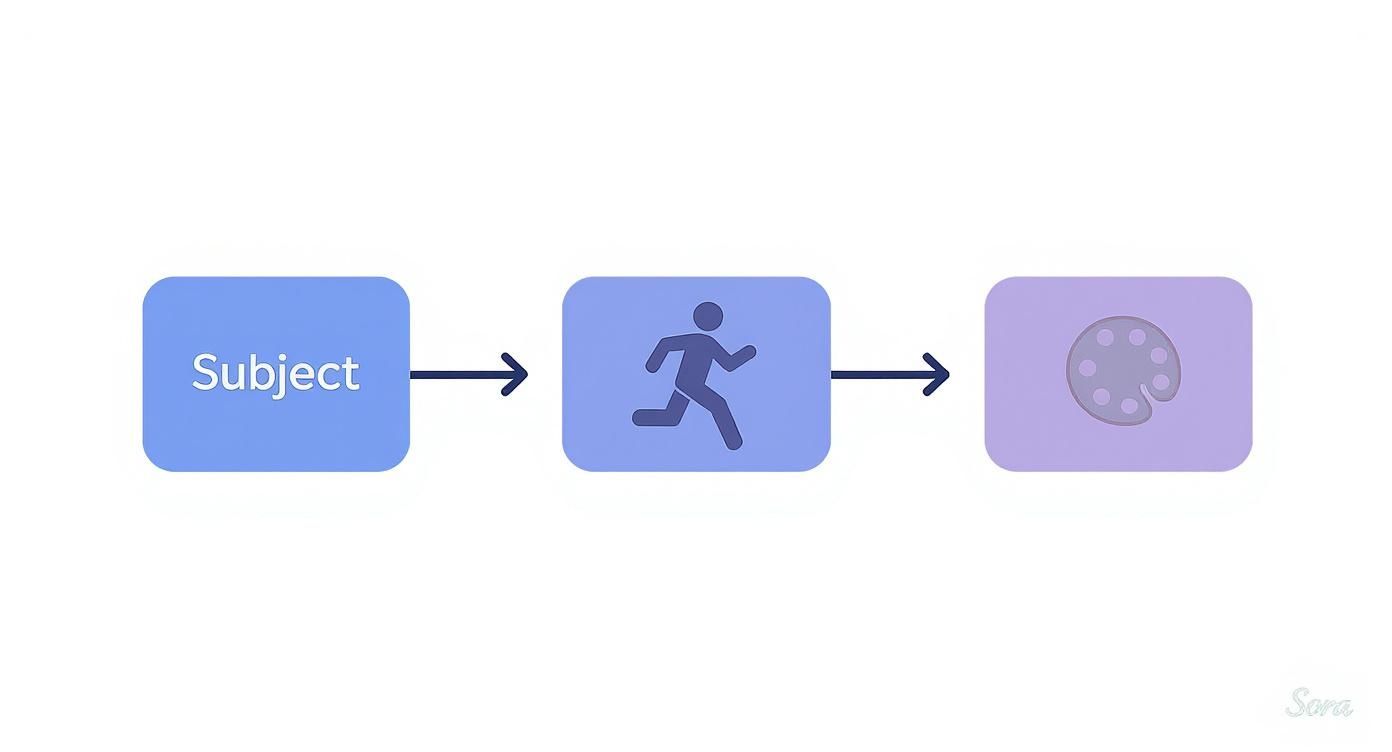
When you see it laid out like this, it’s clear how defining a subject, giving it a compelling action, and wrapping it in a distinct style gives the AI a perfect roadmap.
An Ecommerce Workflow for Product Videos
For an ecommerce site, the mission is completely different. You’re not just stopping a scroll; you're trying to make someone feel like your product belongs in their life. This workflow is all about context, detail, and aspiration, a key benefit of using Sora 2 for ecommerce and product videos.
This is where the new generation of AI really shines. Unlike older models, Sora 2 has incredible world simulation capabilities. It can generate ridiculously complex physical interactions and get the physics right. This improved control means you can tell a multi-shot story while keeping the world consistent, which is a massive leap forward. It’s perfect for showing products in believable, dynamic situations. You can read more about how Sora 2 stacks up against traditional video editing on skywork.ai.
For a product video, I might write a prompt like: "A lifestyle shot of a handcrafted leather watch on a person's wrist as they type on a laptop in a sunlit café. Soft focus on the background, sharp focus on the watch's details. Warm, natural lighting."
Bringing a Static Logo to Life with Image-to-Video
Don't sleep on the power of animating your existing assets. The image-to-video feature is a ridiculously fast way to create dynamic branding content.
Here’s my simple process:
- Upload Your Logo: Start with a high-resolution PNG file of your logo, ideally with a transparent background.
- Prompt the Action: Tell the AI exactly what you want the logo to do. For instance: "The logo materializes from shimmering particles of light, pulses gently, and then resolves into its solid form."
- Set the Scene: If you need a background, describe it. Something like, "against a clean, dark gray background with subtle floating embers."
This quick workflow transforms a flat image into a polished video intro or a slick asset for social media posts. It’s an easy win for adding a layer of professionalism to your brand’s look and feel.
Advanced Tricks and Troubleshooting
Once you've nailed the basics, you'll want to start pushing the Sora 2 animation generator to see what it's really capable of. Getting from "good enough" to "wow, that looks incredible" comes down to understanding how the AI interprets your words and knowing how to fix things when they go wrong. This is where the real artistry begins.
One of the biggest hurdles in longer videos is keeping everything consistent. You’ll notice things like a character’s shirt changing color for no reason or a key object in the background vanishing from one scene to the next. The secret to fixing this is to think of your first prompt not as a one-off command, but as the DNA for your entire project.
Nailing Scene-to-Scene Consistency
To keep your characters, locations, and overall style locked in, you need to work from a detailed "seed" prompt. Don't start from a blank slate for every new clip. Instead, copy your core prompt and just tweak the specific action or camera movement. This is a core function of a Sora 2 storyboard generator.
Let's say this is your seed prompt:
A rugged male adventurer named 'Jax' with a scar over his left eye, wearing a weathered brown leather jacket and dark cargo pants, in a dense, misty jungle. Cinematic lighting, photorealistic style.
For the very next shot, you'd keep that entire description and just bolt on the new action:
...in a dense, misty jungle. **Jax cautiously pushes aside a large fern, revealing a hidden temple entrance.**
By reusing the core elements, you’re telling the AI to pull from the same established world and character model. It’s a simple trick, but it’s hands-down the most effective way to build a story that makes sense.
How to Fix Common Glitches
No matter how good your Sora 2 prompts are, you're going to get some weird results. Distorted faces, wonky physics, bizarre lighting—it's all part of the process. The trick is to diagnose the why instead of just mashing the "regenerate" button and hoping for a different outcome.
-
Warped or Distorted Faces: This is super common in wide shots. The AI simply doesn't have enough pixels to render a clean face from a distance. The fix? Tell it where to put the camera. Add phrases like "medium close-up" or "portrait shot" to your prompt to force the AI to dedicate more processing power to facial details.
-
Unnatural Physics: Seeing objects float or move in impossible ways? Your prompt is probably too vague. You need to anchor your scene in reality. Try adding descriptors like "with realistic gravity" or "showing the object's heavy weight." Get specific about how things should interact with their environment.
-
Flickering or Inconsistent Lighting: If your lighting changes dramatically mid-clip, your initial description was likely too simple. "Sunny day" isn't enough. Get way more specific: "consistent golden hour lighting coming from the right side of the frame."
Pro Tip: Fixing a bad generation is often about removing words, not just adding them. If the AI gives you chaos, look for conflicting adjectives or an overly complicated action. Sometimes, a cleaner, more direct prompt is all you need.
Learning to spot the problem in your own prompt gives you an incredible amount of control. It's this problem-solving mindset that will let you reliably create professional-looking animations with tools like Saro2.ai while others are still just rolling the dice.
Sora 2 AI Video Generation: FAQs
As you start exploring any Sora 2-style animation generator, you're bound to have some questions. This tech is evolving so quickly that what was impossible yesterday is standard today. Here are some of the most common questions about Sora 2 AI video generation.
This is your go-to spot for clearing up those little roadblocks so you can get back to what matters: making incredible videos.
Can I Actually Use This for Commercial Projects?
Yep, you absolutely can. Most Sora 2 style models are built to pump out high-quality, 1080p videos that are perfect for commercial work. The main thing you need to do is glance over the platform's terms of service. Most, including Saro2.ai, give you full commercial rights to whatever you create.
This opens the door for a ton of AI video marketing strategies, like:
- Scroll-stopping Sora 2 for TikTok ads
- Clean product videos for your Shopify store using Sora 2
- Engaging promotional content for social media
My advice? To get that professional polish, write detailed prompts. Get specific about cinematic lighting, crisp product shots, and anything else that matches your brand’s vibe.
How Does This Thing Handle Audio?
This is where Sora 2 really shines. It's a huge step up because it generates synchronized audio right alongside the video. Older tools would just spit out silent clips, leaving you to do the audio work yourself. Now, the Sora 2 video generator can cook up ambient sounds, sound effects, and even simple dialogue that actually matches the action.
For instance, if your prompt is "a rainy city street," you won't just see the rain—you'll hear it, along with the distant sound of traffic. It won't put a professional sound designer out of a job just yet, but it's fantastic for creating an immersive audio foundation without any extra steps.
What Are the Best Sora 2 Alternatives?
While Sora 2 is a beast, it's not the only game in town. There are some really solid Sora 2 alternatives and comparisons to consider, each with its own unique flavor. I've seen a lot of great work come out of tools like Runway Gen-2 and Pika Labs, which are known for their creative controls. Haiper is another one to watch, especially if you want something that's super easy to pick up.
When you're trying to decide, look at the nuts and bolts: video length, resolution, art style (photorealistic vs. anime), and how well it keeps characters consistent. The "best" tool really just depends on what you're trying to accomplish.
Honestly, the best way to find your favorite is to just try them. Most offer free trials. See which one feels right for your workflow and gives you the look you're after.
Ready to turn your ideas into motion? With Saro2.ai, you can start generating stunning, cinematic videos from a few lines of text. Create your first animation in just a few minutes and see what you can dream up. Get started with Saro2.ai today!